Earlier, I had written a short piece l’affaire Reliance (If thy brother wrongs thee…). Like many other well-wishers of Indian economic progress, I am glad that this chapter of public acrimony is done with and the brothers can now compete on business results for the right to be called the true successor of Dhirubhai.
One aspect of this closure which is both tragic and hilarious is how our ministers are tripping over each other to issue a clean chit in respect to all alleged irregularities. Both Chidambaram (Finance) and Gupta (Company Affairs) are busy shouting from the rooftops that this settlement obviates the need for any other enquiry. Look at what Chidambaram says in respect to the allegations leveled by the two sides during the battle (see Times of India here): “I am happy that settlement has been reached. Where is the need for other issues? If there is any specific violation or complaint, we can look into it. [But] after this settlement, I don't think there is any need for an inquiry.” Gupta is quoted later and the sentiments are the same: “since the settlement is already there, I think all the issues are resolved”.
I stake no position on elements of guilt, if any, in the various allegations raised by (current or erstwhile) insiders at the Reliance group. And, same as with Chidambaram and Gupta, it is not my remit to pronounce verdict on the issue. I wish C&G would recognize this and allow the investigators to do their job, and the judiciary (should the investigators find cause to involve this organ of the state), its job.
But again, I am assuming that this is because they know not what they do. What if they do know what they’re doing? What if, like the press during the emergency (“the pressmen had been asked to bend and they began to crawl”), the ministers are just doing what they believe will endear them to the best connected business in town?
Saturday, June 18, 2005


Thursday, June 09, 2005
Ever vigilant - II
Writing in the Guardian (here), Sidney Blumenthal paints a very bleak picture of W’s lieutenants – and of what they’re prepared to do to subvert institutions in their quest for an across-the-board Republican majority, drawing parallels (and making the connection) with Nixon’s regime to make his point. Two things stand out: one, in the matter of Deep Throat and the outing of Watergate scandal M/s Woodward and Bernstein, they may have been more of pawns than center-pieces. Which is not all bad, should you be willing to accept that it’s all personal in the end (Had it not been for Felt’s sense of injustice at having been passed over, would he have mounted the same campaign to out Nixon’s shenanigans? Probably not, but maybe someone else, slighted differently, would’ve had done something similar, one hopes). And second, even in today’s day and age and even in a country as enamored with detailed background checks on public figures as the US, a hard-line clique with such ethically ambiguous past as M/s Cheney, Rove and Rumsfeld have remained at the nerve center of decision-making, pushing their very narrow-minded agenda for a fairly long time.
A good friend who is a proud citizen of the US never fails to remind me of how numerous, deep rooted and powerful the “self correcting mechanisms” in the US society, economy and politics are. In matters such as these, however, I wonder whether I shouldn't ask him to research applicability of Rudi Dornbusch’s work on exchange rates and overshooting to social/ political change too (including, of course, the determination of the degree of overshooting which could materially impair, even if not permanently destroy, some or all of these "self correcting mechanisms").
Once again, the point is simple: we may not have the leverage that Mark Felt had, we may not create the impact that he did but what we will always have is the ability to increase the counterbalancing weight when things overshoot in the wrong direction - for this, as before, we need to remain ever vigilant.
N.b.
51 years ago, on June 9, 1954, US Army counsel Joseph N. Welch confronted US Sen. Joseph R. McCarthy during the Senate-Army Hearings over McCarthy's attack on a member of Welch's law firm, Frederick G. Fisher. Said Welch: "Have you no sense of decency, sir? At long last, have you left no sense of decency?" Read the next day's reporting by New York Times here.
A good friend who is a proud citizen of the US never fails to remind me of how numerous, deep rooted and powerful the “self correcting mechanisms” in the US society, economy and politics are. In matters such as these, however, I wonder whether I shouldn't ask him to research applicability of Rudi Dornbusch’s work on exchange rates and overshooting to social/ political change too (including, of course, the determination of the degree of overshooting which could materially impair, even if not permanently destroy, some or all of these "self correcting mechanisms").
Once again, the point is simple: we may not have the leverage that Mark Felt had, we may not create the impact that he did but what we will always have is the ability to increase the counterbalancing weight when things overshoot in the wrong direction - for this, as before, we need to remain ever vigilant.
N.b.
51 years ago, on June 9, 1954, US Army counsel Joseph N. Welch confronted US Sen. Joseph R. McCarthy during the Senate-Army Hearings over McCarthy's attack on a member of Welch's law firm, Frederick G. Fisher. Said Welch: "Have you no sense of decency, sir? At long last, have you left no sense of decency?" Read the next day's reporting by New York Times here.
Wednesday, June 08, 2005
The many denominations of secular
Amit Chibber commented on yesterday's post, Saagar manthan and referenced the issue of defining secular: which of the definitions - US First Amendment (equal blindness), India (equal affirmation), France (affirmative atheism) - is "correct". I refrained from labeling my preferred definition of secular as “correct” in the original post for the very reason that there are competing versions. I am however, convinced that the ‘blind to religion in matters of state’ interpretation is the only workable solution (and therefore, the “correct” interpretation – should you want me to declare) in a multi-denominational society like ours.
The equal affirmation route, which we have been working with for the past so many decades, can not serve us well on a number of counts: (a) competitive populism – which equal affirmation encourages – is too big a temptation for any politician, and more so for those who have been reared on such a diet since their infancy. Notably, the direction of policy in such competitive populism approximates the ever decreasing spiral that a moth describes in his journey towards the flame; (b) in a society like ours – with the number of denominations being what they are and indeed, with the definition of Hinduism being as broad ranging as it is – it is difficult to find the point (across one, more or all dimensions of policy) which represents ‘equal affirmation’ and we end up on an ever oscillating see-saw where balance, desirable as it may be, is ever elusive; (c) it serves as yet another manifestation of the state as a ‘provider’ in a realm that is essentially private. As for the French interpretation, it is more statist than I am comfortable with and also, it does commit the state to one denomination – to the extent that atheism is, in itself, a doctrine pertaining to religion.
In any case, the framers of Indian constitution did the best in the circumstances they were presented with and we have "equal affirmation" as our guiding light for now. This, however, does not mean that "equally blind" will go against the spirit of our constitutions for, equal affirmation (with the degree of affirmation set to zero) is "equally blind".
The equal affirmation route, which we have been working with for the past so many decades, can not serve us well on a number of counts: (a) competitive populism – which equal affirmation encourages – is too big a temptation for any politician, and more so for those who have been reared on such a diet since their infancy. Notably, the direction of policy in such competitive populism approximates the ever decreasing spiral that a moth describes in his journey towards the flame; (b) in a society like ours – with the number of denominations being what they are and indeed, with the definition of Hinduism being as broad ranging as it is – it is difficult to find the point (across one, more or all dimensions of policy) which represents ‘equal affirmation’ and we end up on an ever oscillating see-saw where balance, desirable as it may be, is ever elusive; (c) it serves as yet another manifestation of the state as a ‘provider’ in a realm that is essentially private. As for the French interpretation, it is more statist than I am comfortable with and also, it does commit the state to one denomination – to the extent that atheism is, in itself, a doctrine pertaining to religion.
In any case, the framers of Indian constitution did the best in the circumstances they were presented with and we have "equal affirmation" as our guiding light for now. This, however, does not mean that "equally blind" will go against the spirit of our constitutions for, equal affirmation (with the degree of affirmation set to zero) is "equally blind".
Tuesday, June 07, 2005
Ever vigilant
A new book by two Washington Post journalists (Kremlin Rising: Vladimir Putin's Russia and the End of Revolution; Peter Baker and Susan B. Glasser; Scribner; 2005) recounts how Mr. Putin has systematically subverted all institutions in Russia that are capable of challenging his authority. An article based on the book appeared in today's Post and can be found here (registration may be required). The article is a must read; specially for those among us who have forgotten - or never cared to find out about - the excesses of emergency. I was reminded of this when someone, waiting with me for an incoming train that was delayed, wistfully spoke of the efficiency in public services during the emergency period.
Absolute power corrupts absolutely - without exception. And, in a democratic setup where democracy is mapped uniquely to the conduct of an electoral process, people forget that elements such as a free press, rule of law, separation of powers etc. are equally important. It is easy to let these institutions and forces decay - specially when vested interests adopt salami tactics and chip away slowly at various peripheral points to ultimately destroy them. In order to ensure that we - or those who come after us - don't live through another period where even habeas corpus is suspended, where elected representatives don't assume that their election means a license to govern autocratically, we need to be ever vigilant.
N.b.
The habeas corpus (literally, produce the body; this writ tests only whether a prisoner has been accorded due process, not whether he is guilty; a safeguard against illegal imprisonment originally formalized in the Habeas Corpus Act of 1679 in England) issue is an extreme example but it is important as a reminder of how much was given up in personal freedom not too far in our past.
On April 28th 1976, 4 of the 5 senior-most Hon'ble Justices of the Supreme Court of India overruled decisions from as many as 9 High Courts in the country in the matter of ADM Jabalpur v Shivakant Shukla [(1976) 2 SCC 521]. They were the then Chief Justice A.N. Ray, along with Justices M.H. Beg, Y.V. Chandrachud and P.N. Bhagwati. The lone dissenting voice was that of Justice H.R. Khanna of whom the New York Times remarked: 'surely a statue would be erected to him in an Indian city'. Justice Khanna paid the price for his dissent. He was next in line to become Chief Justice of India. He resigned when his junior, Justice M.H. Beg, superseded him (for an account of how the 4 Hon'ble Justices tried to use elegant prose to cloak their blatantly craven pronouncement, see Jos. Peter D 'Souza's account in PUCL Bulletin of June 2001 here).
Absolute power corrupts absolutely - without exception. And, in a democratic setup where democracy is mapped uniquely to the conduct of an electoral process, people forget that elements such as a free press, rule of law, separation of powers etc. are equally important. It is easy to let these institutions and forces decay - specially when vested interests adopt salami tactics and chip away slowly at various peripheral points to ultimately destroy them. In order to ensure that we - or those who come after us - don't live through another period where even habeas corpus is suspended, where elected representatives don't assume that their election means a license to govern autocratically, we need to be ever vigilant.
N.b.
The habeas corpus (literally, produce the body; this writ tests only whether a prisoner has been accorded due process, not whether he is guilty; a safeguard against illegal imprisonment originally formalized in the Habeas Corpus Act of 1679 in England) issue is an extreme example but it is important as a reminder of how much was given up in personal freedom not too far in our past.
On April 28th 1976, 4 of the 5 senior-most Hon'ble Justices of the Supreme Court of India overruled decisions from as many as 9 High Courts in the country in the matter of ADM Jabalpur v Shivakant Shukla [(1976) 2 SCC 521]. They were the then Chief Justice A.N. Ray, along with Justices M.H. Beg, Y.V. Chandrachud and P.N. Bhagwati. The lone dissenting voice was that of Justice H.R. Khanna of whom the New York Times remarked: 'surely a statue would be erected to him in an Indian city'. Justice Khanna paid the price for his dissent. He was next in line to become Chief Justice of India. He resigned when his junior, Justice M.H. Beg, superseded him (for an account of how the 4 Hon'ble Justices tried to use elegant prose to cloak their blatantly craven pronouncement, see Jos. Peter D 'Souza's account in PUCL Bulletin of June 2001 here).
Saagar manthan (Churning the ocean)
Mr. Advani has predictably raised a storm back home with his Jinnah/secular remark in Pakistan. See news stories here and here. From what one knows of his habits, Mohammad Ali Jinnah was obviously no fundamentalist. Even in his political life, there are two phases: one where he was purely supporting the cause of Indian independence (somewhat desultorily, by many accounts) and then, when he was made the urbane spokesman of the two-nation argument. Be that as it may (this posting is not about whether Jinnah was secular or not: secularism, as only a very few realize, should not be about EQUAL treatment to all religion by the state - which is impractical - but should be about being BLIND to religion in matters of state), I am extremely pleased with this development – and, to the extent that we won’t see another backtracking of the type “I have been misquoted; what I really meant was the exact opposite of what you heard”, this is a (or the beginning of a) momentous development in our politics.
Till date, we struggled to choose from Congress-I (center-left, old, ever willing to pander to all kinds of minorities in the name of secularism and social justice, corrupt, centralized, autocratic), regional parties (parochial, rural focused, state-as-a-gravy-train mentality), BJP (extreme right-wing, old, corrupt) and the Left (irrelevant but refuses to die). With this development what I see is – shorn of all (and there will be many during the transition) complications – the emergence of the first center-right national alternative (while the NDA was, arguably, center-right in its conduct, that was much more due to the compulsions of coalition politics than there being a unifying center-right ideology to begin with).
It is imperative that, over time, we reach a point where (with economies of scale kicking-in for the political process) the electorate has clear choices to make between center-left and center-right alternatives (should the 2-3 party kind of system truly take root, they will each be somewhere close to the center), instead of choosing from numerous competitors and then leaving the bartering (with all attendant shenanigans) to the elected representatives (or, to their leaders/brokers). This is required for our executive (as long as the executive comprises a sub-set of the legislature) to be incented in taking a pan-India, development-focused view on issues.
I have been – and, as of now, remain – strongly against BJP policies (e.g. education, role of religion in public life, swadeshi vs. free-trade, etc.). But, as this drama plays out – and it will take years, not months or days, I hope to be one of the many who will have a real choice between two parties that have the same warts (the two-party system won’t necessarily take out corruption, centralization-of-power etc. issues) but different promises on (goals of and path towards) social and economic development.
Till date, we struggled to choose from Congress-I (center-left, old, ever willing to pander to all kinds of minorities in the name of secularism and social justice, corrupt, centralized, autocratic), regional parties (parochial, rural focused, state-as-a-gravy-train mentality), BJP (extreme right-wing, old, corrupt) and the Left (irrelevant but refuses to die). With this development what I see is – shorn of all (and there will be many during the transition) complications – the emergence of the first center-right national alternative (while the NDA was, arguably, center-right in its conduct, that was much more due to the compulsions of coalition politics than there being a unifying center-right ideology to begin with).
It is imperative that, over time, we reach a point where (with economies of scale kicking-in for the political process) the electorate has clear choices to make between center-left and center-right alternatives (should the 2-3 party kind of system truly take root, they will each be somewhere close to the center), instead of choosing from numerous competitors and then leaving the bartering (with all attendant shenanigans) to the elected representatives (or, to their leaders/brokers). This is required for our executive (as long as the executive comprises a sub-set of the legislature) to be incented in taking a pan-India, development-focused view on issues.
I have been – and, as of now, remain – strongly against BJP policies (e.g. education, role of religion in public life, swadeshi vs. free-trade, etc.). But, as this drama plays out – and it will take years, not months or days, I hope to be one of the many who will have a real choice between two parties that have the same warts (the two-party system won’t necessarily take out corruption, centralization-of-power etc. issues) but different promises on (goals of and path towards) social and economic development.
Wednesday, June 01, 2005
People like us
It is after a very long while that I have read a considered piece by someone owing allegiance to the left. In today’s Indian Express, Dipankar Mukherjee (CPI-M, Rajya Sabha) justifies the need for a CBI inquiry into the sale of the two Centaur hotels in Mumbai. The article can be found here.
The case for a preliminary enquiry exists. That much was, I think, clear even when one went through the 3-part ‘anticipatory defense’ by Mr. Shourie (writing in the same newspaper a few days ago – see here). He had, in his inimitable style, not just decimated a number of uninformed (or under-informed) reporters who posed silly questions to him but had extended the discussion to covering “why I did what I did”. And it is in this that he needs to pause and reflect whether he himself is not using an “elastic foot-ruler”: had this been an instance of a Congress-I disinvestment minister and Arun Shourie, the journalist that he used to be, his conclusions would be quite different than what they are now.
Mr. Mukherjee has made more detailed points in his article (and has of course succumbed to the temptations of exaggerating some accusations) but the core issues are these: One, that these units were to be sold as going concerns and in each of the Centaur examples, not just the actual actions after the event but also the discernible intent in advance point to them being speculative transactions. Two, in respect to the encashment of bank guarantees, why the laxity shown to Mr. Kerkar? After all, is it not for such infringements that Mr. Shourie (the journalist) would reserve his most passionate moral indignation? Why allow the two extensions to Mr. Kerkar, if the agreed procedures were that, should he not pay up, the guarantee is to be forfeited; or, if a DoD official has already opined that the incremental bank guarantee has "infirmities", what business is it of DoD to have the bankers come over and redraft the guarantee – shouldn’t Mr. Kerkar’s company be responsible for submitting a guarantee that meets with DoD’s requirements?
I am completely one with those who believe that Mr. Shourie brought a degree of probity rarely encountered in the executive branch of our government. However, that does not imply he is above the law and/or should have any special privileges in respect to scrutiny of his actions. And when he makes such a big deal of the possibility of an enquiry: “We should look upon allegations and inquiries as one of the ‘conditions of employment,’ so to say; as one of the things we will have to put up with—like transfers to out-of-the-way places—as the price of doing good work in the India of today” Mr. Shourie forgets that others have been living this reality for years, it has always been a ‘condition of employment’ and countless bureaucrats have had to walk through this hell already.
What is to be gained by perpetuating the mistakes (motivated/ unnecessary enquiries) of the past? Just this: our criminal justice system needs a thorough shake-up (on the twin poles of independence for investigating agencies and counterbalance in some shape to check excesses and/or provide some measure of possible relief to those who will be incorrectly charged/implicated in wrongdoing) and unless that happens, the standards should be applied uniformly. Also, note that even this argument presupposed Mr. Shourie’s innocence in terms of both commission and omission. But, isn’t it entirely possible that Mr. Shourie’s placement was a mask (to use the unfortunate term that got Mr. Govindacharya expelled) behind which other, more powerful elements were continuing in their shenanigans? Isn’t it also possible (though less so, I think) that Mr. Shourie was blind to procedural issues (and/or implications) in his zeal to “reform the system”? (If so, he should’ve had spoken up for – and acted towards – reforming the procedures and not to circumvent them and expect the world to applaud.)
And, finally, there is one nugget buried in Mr. Mukherjee’s piece that deserves greater attention. He writes, “The CAG report has been labeled ‘unworthy of the high constitutional authority’, ‘elastic foot ruler’, etc., by those who claim to be the upholders of parliamentary democracy in the country” and then reminds us “If Laloo Prasad Yadav talks about the Election Commission, everybody including the media takes exception. Yet, no one bats an eyelid when CAG is so ridiculed”. Indeed: let us not have our own “elastic foot-rulers” to judge people differently. I am no fan of Mr. Yadav's style of business - but he deserves only the same opprobrium as we are prepared to deliver, in similar instances, on others of his calling.
The case for a preliminary enquiry exists. That much was, I think, clear even when one went through the 3-part ‘anticipatory defense’ by Mr. Shourie (writing in the same newspaper a few days ago – see here). He had, in his inimitable style, not just decimated a number of uninformed (or under-informed) reporters who posed silly questions to him but had extended the discussion to covering “why I did what I did”. And it is in this that he needs to pause and reflect whether he himself is not using an “elastic foot-ruler”: had this been an instance of a Congress-I disinvestment minister and Arun Shourie, the journalist that he used to be, his conclusions would be quite different than what they are now.
Mr. Mukherjee has made more detailed points in his article (and has of course succumbed to the temptations of exaggerating some accusations) but the core issues are these: One, that these units were to be sold as going concerns and in each of the Centaur examples, not just the actual actions after the event but also the discernible intent in advance point to them being speculative transactions. Two, in respect to the encashment of bank guarantees, why the laxity shown to Mr. Kerkar? After all, is it not for such infringements that Mr. Shourie (the journalist) would reserve his most passionate moral indignation? Why allow the two extensions to Mr. Kerkar, if the agreed procedures were that, should he not pay up, the guarantee is to be forfeited; or, if a DoD official has already opined that the incremental bank guarantee has "infirmities", what business is it of DoD to have the bankers come over and redraft the guarantee – shouldn’t Mr. Kerkar’s company be responsible for submitting a guarantee that meets with DoD’s requirements?
I am completely one with those who believe that Mr. Shourie brought a degree of probity rarely encountered in the executive branch of our government. However, that does not imply he is above the law and/or should have any special privileges in respect to scrutiny of his actions. And when he makes such a big deal of the possibility of an enquiry: “We should look upon allegations and inquiries as one of the ‘conditions of employment,’ so to say; as one of the things we will have to put up with—like transfers to out-of-the-way places—as the price of doing good work in the India of today” Mr. Shourie forgets that others have been living this reality for years, it has always been a ‘condition of employment’ and countless bureaucrats have had to walk through this hell already.
What is to be gained by perpetuating the mistakes (motivated/ unnecessary enquiries) of the past? Just this: our criminal justice system needs a thorough shake-up (on the twin poles of independence for investigating agencies and counterbalance in some shape to check excesses and/or provide some measure of possible relief to those who will be incorrectly charged/implicated in wrongdoing) and unless that happens, the standards should be applied uniformly. Also, note that even this argument presupposed Mr. Shourie’s innocence in terms of both commission and omission. But, isn’t it entirely possible that Mr. Shourie’s placement was a mask (to use the unfortunate term that got Mr. Govindacharya expelled) behind which other, more powerful elements were continuing in their shenanigans? Isn’t it also possible (though less so, I think) that Mr. Shourie was blind to procedural issues (and/or implications) in his zeal to “reform the system”? (If so, he should’ve had spoken up for – and acted towards – reforming the procedures and not to circumvent them and expect the world to applaud.)
And, finally, there is one nugget buried in Mr. Mukherjee’s piece that deserves greater attention. He writes, “The CAG report has been labeled ‘unworthy of the high constitutional authority’, ‘elastic foot ruler’, etc., by those who claim to be the upholders of parliamentary democracy in the country” and then reminds us “If Laloo Prasad Yadav talks about the Election Commission, everybody including the media takes exception. Yet, no one bats an eyelid when CAG is so ridiculed”. Indeed: let us not have our own “elastic foot-rulers” to judge people differently. I am no fan of Mr. Yadav's style of business - but he deserves only the same opprobrium as we are prepared to deliver, in similar instances, on others of his calling.
Smoke and mirrors
This is plain absurd: yesterday, the government imposed an outright ban on the depiction of smoking and tobacco products in cinemas, TV and (this bit is unclear) in any other visual media. See news stories here and here. It appears that, after a 2-month grace period, even the older creatives telecast on TV or shown in public theatres will have to have cigarettes blurred over (Question: in the next round, will the police go house-by-house with editing equipment for people who may have video cassettes, CDs or DVDs of such offending material? Answer: Don’t bet against it).
Before I proceed further, here’s some relevant background: I am a reformed (actually, trying to be reformed – the urge never goes away for the rest of your life, I am told) smoker myself and can attest to the fact that despite full knowledge of terrible health consequences, it is a difficult addiction to get rid of. I have also, previously, worked in a different industry that trades in another socially acceptable vice: beverage alcohol and know that private commercial concerns usually trump inclinations of being socially responsible: surrogate advertising etc. will flourish unless there’s a coincidence of clear regulation and spirited (no pun intended) enforcement.
There will be a number of arguments from both sides but here’s my simple contention – in their zeal to protect the children (as they see their citizens, no – their subjects), isn’t the government hitting a more fundamental right (in respect of free speech)? As long as smoking is not illegal, how is the depiction of smoking illegal? Please do not confuse this with advertising – which the government, in its zeal to discourage smoking, can regulate or prohibit: the overwhelming majority of instances where smoking is depicted in films are not related to paid insertions instigated by tobacco manufacturers. And, to the extent that these are depictions that influence impressionable minds, let us use the powers of moral suasion to create change where possible. Where it is not possible, let us agree to disagree (“I do not agree with what you have to say, but I'll defend to the death your right to say it”) and expend our energies on educating citizens about the ills of smoking. There’s the “slippery slope” argument, of course – the nanny state starting with this and moving on to banning, progressively, dangerous driving, conspicuous consumption and other ‘undesirable’ elements from the screen (Why only the screen? Why not the printed word next?). There’s the “too many laws, too few implementation” argument – instead of creating another set of prohibitions, why can’t we have better enforcement of those which already exist in this respect i.e. the one about “no smoking in public places”.
Finally (and should any of you think this is frivolous, remember that there are temples to this living deity), how will you blur out (without jeopardizing its entire artistic merit) a sequence where the cigarette is tossed up, spins many times, is caught between the lips and – in the meanwhile – a pistol has materialized which is fired to light the cigarette! To think that we will be fooled by a blur replacing the cigarette! Rascals!
N.b.
“Next morning I got up late on account of the big fee I had earned the night before. I drank an extra cup of coffee, smoked an extra cigarette, ate an extra slice of Canadian bacon, and for the three hundredth time I swore I would never again use an electric razor. That made the day normal.” Raymond Chandler, The Long Goodbye (1953)
Before I proceed further, here’s some relevant background: I am a reformed (actually, trying to be reformed – the urge never goes away for the rest of your life, I am told) smoker myself and can attest to the fact that despite full knowledge of terrible health consequences, it is a difficult addiction to get rid of. I have also, previously, worked in a different industry that trades in another socially acceptable vice: beverage alcohol and know that private commercial concerns usually trump inclinations of being socially responsible: surrogate advertising etc. will flourish unless there’s a coincidence of clear regulation and spirited (no pun intended) enforcement.
There will be a number of arguments from both sides but here’s my simple contention – in their zeal to protect the children (as they see their citizens, no – their subjects), isn’t the government hitting a more fundamental right (in respect of free speech)? As long as smoking is not illegal, how is the depiction of smoking illegal? Please do not confuse this with advertising – which the government, in its zeal to discourage smoking, can regulate or prohibit: the overwhelming majority of instances where smoking is depicted in films are not related to paid insertions instigated by tobacco manufacturers. And, to the extent that these are depictions that influence impressionable minds, let us use the powers of moral suasion to create change where possible. Where it is not possible, let us agree to disagree (“I do not agree with what you have to say, but I'll defend to the death your right to say it”) and expend our energies on educating citizens about the ills of smoking. There’s the “slippery slope” argument, of course – the nanny state starting with this and moving on to banning, progressively, dangerous driving, conspicuous consumption and other ‘undesirable’ elements from the screen (Why only the screen? Why not the printed word next?). There’s the “too many laws, too few implementation” argument – instead of creating another set of prohibitions, why can’t we have better enforcement of those which already exist in this respect i.e. the one about “no smoking in public places”.
Finally (and should any of you think this is frivolous, remember that there are temples to this living deity), how will you blur out (without jeopardizing its entire artistic merit) a sequence where the cigarette is tossed up, spins many times, is caught between the lips and – in the meanwhile – a pistol has materialized which is fired to light the cigarette! To think that we will be fooled by a blur replacing the cigarette! Rascals!
N.b.
“Next morning I got up late on account of the big fee I had earned the night before. I drank an extra cup of coffee, smoked an extra cigarette, ate an extra slice of Canadian bacon, and for the three hundredth time I swore I would never again use an electric razor. That made the day normal.” Raymond Chandler, The Long Goodbye (1953)
Sunday, May 29, 2005
Caveat emptor! (Standard Chartered; Credit cards)
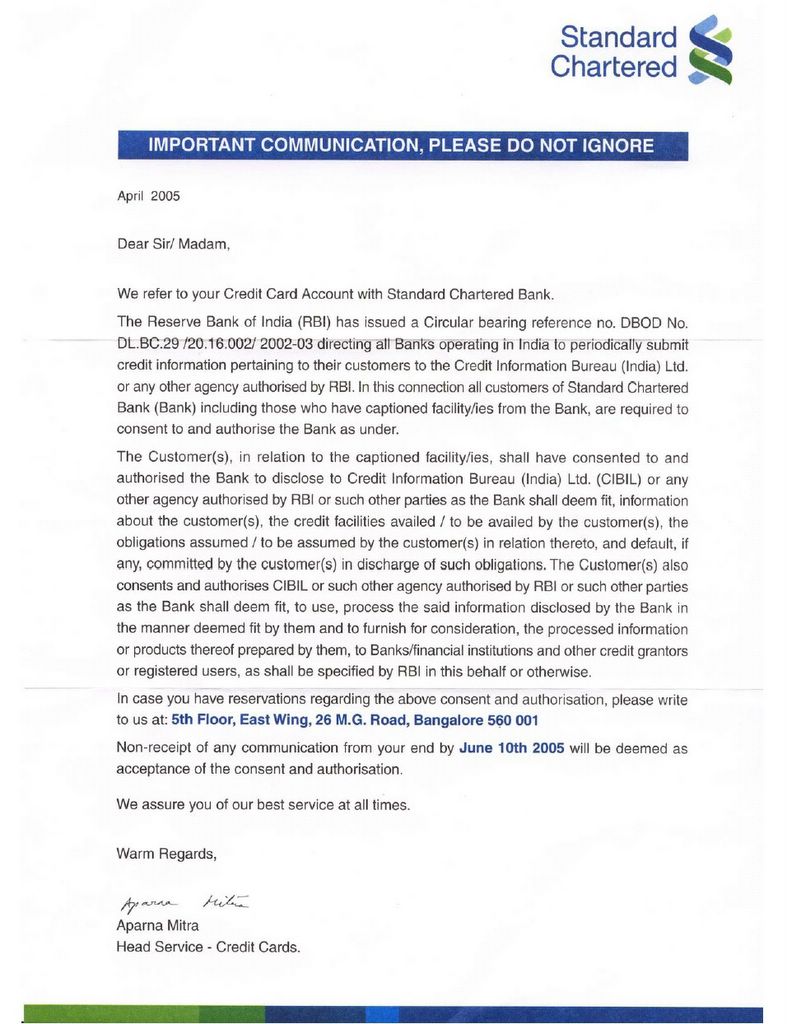 Ms Aparna Mitra (Head Service – Credit Cards) of Standard Chartered Bank has sent a letter to the cardholders of the bank requiring consent from the customers (actually, not as much as requiring as intimating the assumption of consent – the letter states “Non-receipt of any communication from your end by June 10th 2005 will be deemed as acceptance of consent and authorization”) in respect to sharing customer information with other parties.
The letter is made out as being occasioned by a (3-year old) circular from the Reserve Bank of India “bearing reference no. DBOD No. DL.BC.29/ 20.16.002/ 2002-03 directing all Banks operating in India to periodically submit credit information pertaining to their customers to the Credit Information Bureau (India) Ltd. or any other agency authorized by RBI”
In a classic sleight-of-hand, the letter then goes on to construct a clause for consent and authorization that goes much beyond what the RBI requires and where any future extension of consent and authorization will be beyond what is required by an independent body such as the RBI.
According to the clause which all customers are required to agree:
“authorize the Bank to disclose to Credit Information Bureau (India) Ltd. (CIBIL) or any other agency authorized by RBI or such other parties as the Bank shall deem fit” (note that “the Bank” is Standard Chartered); “The Customer(s) also consent and authorizes CIBIL or any such other agency authorized by RBI or such parties as the Bank shall deem fit, to use, process the said information disclosed by the Bank in the manner deemed fit by them and to furnish for consideration, the processed information or products thereof prepared by them, to Banks/ financial institutions and other credit grantors or registered users, as shall be specified by RBI in this behalf or otherwise” (Emphasis provided)
In one stroke, Standard Chartered is not just assuming full ownership of all information that customers have submitted but is also abrogating the right to provide it – free or otherwise – to anyone it pleases, for any purpose that Standard Chartered or the subsequent entity (in whose hands this information reaches) may want to use it for.
And Standard Chartered is doing this beautifully – by just appending a few words to what the RBI is requiring it to do (for the record, the creation of CIBIL and RBI’s support to this new organization in form of requiring banks to share data with CIBIL is an extremely important and beneficial step for all involved in the personal credit industry – including customers – in our country).
Why is this important at all? Well, as an overarching cause, note that they’re taking your and my personal particulars (including, but not just restricted to, financial data) and trading in it – which is absolutely not their remit. And, to be very specific, note that the next time an auto-loan salesperson calls you on your mobile phone, you have actually authorized that call to be made.
No wonder there are a number of people who despise these MNCs (in banking or otherwise): Standard Chartered wouldn’t have tried such a trick in any developed market that it operates in – it is using the lower standards (with respect to data protection and consumer awareness) prevalent in this country to “get away with what it can”. Despicable. Next, consider that it is such exploitation of loopholes that lead to the government and regulatory agencies becoming very prescriptive in their recommendations – so, the RBI could have had issued a circular with specific wording on the communication between banks and their customers. But, had that been the case, I am sure there would be editorials and (planted?) news stories about “license-raj-mentality” or “overzealous regulators” and such like.
For things to change (without throwing out the baby with the bathwater), at least one of the three conditions – consumers becoming powerful as an organized group, RBI’s ombudsman becoming proactive and powerful, some sort of a producers guild becoming forward looking in respect to consumer issues – need to be met. Till then, thank you very much but I do not want any personal loans, so don't call me: should my needs change, I will call you.
N.b.
I have written to Ms Mitra at the address supplied, specifically excluding the discretionary portions from the consent, but I doubt if she or her employer will pay any heed (surprise me, StanChart).
Saturday, May 28, 2005
The Persian Letters – I (What Democracy?)
Usbek to Rhedi,
at Ishfahan
at Ishfahan
There is no escaping the noise generated about the democratic status of this country. It comes through in many ways: state-sponsored celebrations twice a year, (relatively) high rates of electoral participation, (as a part of) explanation by numerous commentators for moderate rates of growth and change, the chest-thumping variety displayed by politicians etc. Importantly, this pride isn't restricted to the man on the street; journalists, social scientists, bureaucrats, lawyers (i.e. people who one can reasonably expect will know better) also use democracy to explain many successes and condone many shortcomings of what goes on around here. However, both in their writings and in my conversations with (a sub-set of) them, I can't seem to find anyone who truly appreciates (and applies) the range of conditions that need to be satisfied to earn the label of democracy.
Let us start at the beginning: "In a democracy, the people are sovereign. They may govern through ministers, or be advised by a senate, but they must have the power of choosing their ministers and senators for themselves." All around me, I see people that are servile, not sovereign; and ministers and parliamentarians who, in all senses of the word, are rulers. And the power of choosing ministers: that's been abdicated to a coterie of brokers. They used to ridicule one dynasty in this country - now these are too common to be ridiculed. Socialists of varying convictions are inducting their progeny into politics. A well educated, young, 3rd-generation politician was proudly holding forth on a talk-show: "if a lawyer's son practices law or a doctor's son also becomes a doctor, there's no comment so why should there be any when a politician's son enters politics", and the young lady who was hosting the show could do no better than "So there you have it: that's a pretty strong logic that Omar has laid out...".
You will recall that Montesquiue wrote of the principle of democracy being political virtue i.e. "the love of the laws and of our country". By just this yardstick, this democracy doesn't measure up at all. The love of the laws has all but disappeared: in its place, you now see anything ranging from impatient tolerance to impudent flouting of it. Indeed, this has come to pass, in no small manner by the fact that laws have proliferated to an extent that they that are now too numerous to even track while enforcement is sporadic at the best of times and, in worse instances, it is motivated and malafide. Is it changing, you ask? Just consider this: almost one-fifth of the Central lawmakers have serious criminal charges pending against them; and this ratio is trending steadily upward. Any demand for changing the rules of the game - not that there have been very many coherent ones - is met with strident cries of "attack on democracy" and "anti-people elitist conspiracy".
Let's stay with Montesquieu for some more time today. He wrote of democracy becoming corrupted in two possible ways - "the spirit of inequality" and "the spirit of extreme equality". It is clear to all animals - save, of course, the ostriches that we have many of - that this land was been systematically pillaged in the first manner over a long period (and the loot hasn't ceased yet) and, of late, the second kind of corruption has also spread to many parts (in different guises).
The spirit of inequality - "when citizens no longer identify their interests with the interests of their country, and therefore seek both to advance their own private interests at the expense of their fellow citizens, and to acquire political power over them" - was possibly always with this country but in the post-independence era, it characterized the governance and administration of the entire country. Bureaucrats and politicians (mostly owing allegience to the Congress party, as those were largely unipolar days) literally ruled the country and while I hear talk of inequality and differnces in development as if these are issues of recent vintage, I open my books and see that poets were cautioning the rulers about inequality in the 1960s: "Sakal desh mein haalahal hai, dilli mein hala hai/ Dilli mein roshani sesh bharat mein andhiyala hai/ Makhmal ke pardon ke baahar, phoolon ke us paar/ Jyon ka tyon khada aaj bhi marghat sa sansaar" (Ramdhari Singh 'Dinkar'; Samar shesh hai).
The spirit of extreme equality, when the people are no longer content to be equal as citizens, but want to be equal in every respect, when they "want to manage everything themselves, to debate for the senate, to execute for the magistrate, and to decide for the judges" is a more recent phenomenon but has taken roots as deep as the former malady. A number of individuals in politics have appealed to narrow sectarian interests (divisions on various lines: a mix of regional and religious identity with Mr. Bal Thackeray; caste-based groupings in the Hindi heartland) and, having established these vote banks have now extended the license to claiming to be above any law because they have the "popular mandate" and publicly wonder why "if the people don't consider us to be criminals and vote us to the parliament, who is the court to label us thus?"
Eventually, as Montesquieu pointed out, the government will cease to function, the last remnants of virtue will disappear, and democracy will be replaced by despotism.
What is the redeeming feature, then? The quinquennial electoral process which is "free and fair" and where a surprisingly high proportion of the eligible voters participate? People are justly proud of both the scale in participation and the overall conduct of this "festival of democracy". However, this is just the form of democracy and not its bedrock. Those bedrock principles, as I explained earlier, have been eroded over many years and are now less capable than ever of sustaining this edifice.
How can they shore up the structure then? Can they? One certainly hopes so (after all, one-sixth of the world is involved)! There are a number of steps that can be taken - indeed, must be taken - which vary in their points of incidence, in the significance of their impact and in the lag between their administration and results. Many of these are well known but the notion that the malady will only respond to a well-considered cocktail of drugs (or, for when you prefer less contemporarily inclined language, to a well-considered portfolio of interventions) is still not as developed as it should be (prescriptions that approximate a laundry list are plentiful, though).
In my next letter, I will make the case for the portfolio approach - and hopefully be able to distinguish it (in its reasoning) from the laundry lists - and then, in subsequent dispatches, talk about some of the most urgent and some of the most important elements within the portfolio.
Thursday, May 26, 2005
Those who forget history are condemned to repeat it
If you haven’t read Jerry Rao’s op-ed piece in today’s Indian Express, you must – it can be found here. It is an excellent illustration of how we act as if it is only by taking extremely radical positions that we can combat extremism in competing, entrenched claims. It is also an illustrative instance of how many among us are willing to ascribe goodness and light to acts – and not just to acts, but also to the associated individuals (forgetting completely that the two are linked by that crucial bridge called motive) – of many years, decades or centuries ago.
In today’s article, Mr. Jaithirth Rao presents his case for revisiting the scorn heaped upon one of the representatives of the Crown – Thomas Babington Macaulay. Mr. Rao – in breathless prose – labels Macaulay “the most important founding father of modern India” and contests “Without his gift to us, so many of us would be lesser individuals, not just different individuals”. And it is not just us common people who should be thankful – he goes on thus: “It is trite to state that not only R.K. Narayan and Salman Rushdie, but the very constitution of the Republic of India and the landmark judgments of its jurists are all a direct fallout of Macaulay’s historic minute”. My my, strong words indeed!
Of course, Mr. Rao seems to have read the original Minutes – in which Macaulay makes his case – and therefore acknowledges that “Macaulay ridiculed traditional Indian knowledge as useless, deluded and shallow. He alleged that Indian histories talked about reigns of kings that were forty-thousand years long and geographies made reference to seas of treacle and whey”. But he makes light of these, claiming that there’s “some justification in this harsh criticism” (as indeed there is) and reserves his opprobrium (“stupid Whig smugness”) only in relation to Macaulay’s views on Indian literature.
Now, I must confess to liking some of Mr. Rao’s previous op-ed pieces and find him to be, on balance of evidence, one of the better commentators represented in our popular press. This article, however, is unadulterated trash (Too harsh, is it? I am using the same license here as in “Swadeshi chauvinist or a dim-witted leftist” used to describe people who dislike Macaulay). Here's why.
He says, “Such indeed are the ironies of history. A person who oddly enough is central to the history of the conquered is quite irrelevant in the annals of the conquerors… … in any event you cannot ignore Macaulay and his enduring decisive intervention in India’s history.” Macaulay’s irrelevance in Britain is of little concern to me and not at all as surprising as Mr. Rao makes it out to be. However, on the other point, had Mr. Rao referred to Macaulay’s work in respect to constructing the Indian Penal Code – which is still the mainstay of our criminal law – yes, we could debate the ‘enduring decisive intervention’ because, whether you know it or not, IPC applies to everyone among us (and has remained largely unchanged despite the passage of much time). As for English, there are only about 60% of our countrymen (and women) who don’t know the language and while it disadvantages them in respect to job opportunities (specially in sectors such as IT and ITES – where Mr. Rao works), it is not the end of the world.
Mr. Rao's claim of “to think of India without the English language is pretty much like thinking of India without the monsoons. It may not touch everyone, but its influence touches everyone” should be seen in this light. English education, even today, is restricted to a minority: an increasing minority (happily, given today’s world economic order), but still very much a minority so I wouldn’t term this intervention as “decisive” in “Indian history”.
And before you start off on themes of “he wants to keep them down… the path to economic freedom is learning English… etc”, please allow me to remind you that it is only one of the possible paths – indeed, should one look closer home (e.g. Japan in the 1950s and 1960s, Korea in the 1960s and 1970s, or China in 1980s and 1990s), it will be apparent that economic growth – specially the kind that is manufacturing led and whose benefits are distributed among a larger section of population – is independent of widespread English-language skills among the population. It is my contention – and open to rebuttal, like any other – that going forward, if we are to realize the true economic potential of India (e.g. as captured in predictions of Morgan Stanley’s BRIC report), the role played by non English-dependent jobs (e.g. manufacturing for the world, growth in internal services e.g. retailing etc.) will be far more important than the experience of the past decade may lead us to believe.
Next, in referencing things such as “Vivekananda on Vedanta, Coomaraswamy on Indian Art, Aurobindo Ghose on Vedic Mysticism, Radhakrishnan on the Hindu View of Life, Krishnan on Indian Wildlife, Srinivas on Caste, Zakaria on Indian Muslims, etc.” to make the point that English is not just “a medium or a means to an end; it is part of our very consciousness”, Mr. Rao grossly shortchanges these thinkers. Is it a fair contention that their works would’ve had been lesser in inputs, analysis or impact had their medium been an Indian language? Did Voltaire – or any of the contemporary French thinkers – miss out because their consciousness was bereft of the full glory of the English language? After all, had the creeping acquisition of English not been injected into us, what is to say that literary and intellectual progress as in France would not have taken place?
And, let me hasten to add: I am not, for a moment, advocating that there is any cause to turn back the clock or even think of “righting historical wrongs” (a habit which our BJP friends are partial towards) but let us not twist facts to support a specious argument.
Macaulay, in his minutes, draws analogies with not just “untutored Russians before Peter the Great transformed them” but also Europe coming into the age of letters. And both these analogies are spurious with respect to justifying the imposition of English. I don’t have to make a new case: H. T. Prinsep, who was Secretary (Education) in that era, had the following to say in respect of the Russian analogy: “The analogy of Russia is less convincing. It is through communication with foreigners through imitation and translations that the Russians are building up a native literature. This is the method that is specifically advocated by those who despair of making English the language of general adoption or the vehicle for imparting a knowledge of the sciences to the millions who compose the population of India. The argument would only have weight if, in the schools and colleges of Russia, German were now or had ever been the exclusive organ through which the youth of that country derived instruction which it assuredly is not and never was.” For Macaulay’s reference to importance of Latin in renaissance and equating that to usage of English for India’s renaissance, Prinsep reminded Macaulay that “This however is not the true analogy – Latin and Greek were to the nations of Europe what Arabic and Persian are to the Mooslims and Sanscrit to the Hindoos of the present population of Hindoostan and if a native literature is to be created it must be through the improvements of which these are capable.”
In today’s article, Mr. Jaithirth Rao presents his case for revisiting the scorn heaped upon one of the representatives of the Crown – Thomas Babington Macaulay. Mr. Rao – in breathless prose – labels Macaulay “the most important founding father of modern India” and contests “Without his gift to us, so many of us would be lesser individuals, not just different individuals”. And it is not just us common people who should be thankful – he goes on thus: “It is trite to state that not only R.K. Narayan and Salman Rushdie, but the very constitution of the Republic of India and the landmark judgments of its jurists are all a direct fallout of Macaulay’s historic minute”. My my, strong words indeed!
Of course, Mr. Rao seems to have read the original Minutes – in which Macaulay makes his case – and therefore acknowledges that “Macaulay ridiculed traditional Indian knowledge as useless, deluded and shallow. He alleged that Indian histories talked about reigns of kings that were forty-thousand years long and geographies made reference to seas of treacle and whey”. But he makes light of these, claiming that there’s “some justification in this harsh criticism” (as indeed there is) and reserves his opprobrium (“stupid Whig smugness”) only in relation to Macaulay’s views on Indian literature.
Now, I must confess to liking some of Mr. Rao’s previous op-ed pieces and find him to be, on balance of evidence, one of the better commentators represented in our popular press. This article, however, is unadulterated trash (Too harsh, is it? I am using the same license here as in “Swadeshi chauvinist or a dim-witted leftist” used to describe people who dislike Macaulay). Here's why.
He says, “Such indeed are the ironies of history. A person who oddly enough is central to the history of the conquered is quite irrelevant in the annals of the conquerors… … in any event you cannot ignore Macaulay and his enduring decisive intervention in India’s history.” Macaulay’s irrelevance in Britain is of little concern to me and not at all as surprising as Mr. Rao makes it out to be. However, on the other point, had Mr. Rao referred to Macaulay’s work in respect to constructing the Indian Penal Code – which is still the mainstay of our criminal law – yes, we could debate the ‘enduring decisive intervention’ because, whether you know it or not, IPC applies to everyone among us (and has remained largely unchanged despite the passage of much time). As for English, there are only about 60% of our countrymen (and women) who don’t know the language and while it disadvantages them in respect to job opportunities (specially in sectors such as IT and ITES – where Mr. Rao works), it is not the end of the world.
Mr. Rao's claim of “to think of India without the English language is pretty much like thinking of India without the monsoons. It may not touch everyone, but its influence touches everyone” should be seen in this light. English education, even today, is restricted to a minority: an increasing minority (happily, given today’s world economic order), but still very much a minority so I wouldn’t term this intervention as “decisive” in “Indian history”.
And before you start off on themes of “he wants to keep them down… the path to economic freedom is learning English… etc”, please allow me to remind you that it is only one of the possible paths – indeed, should one look closer home (e.g. Japan in the 1950s and 1960s, Korea in the 1960s and 1970s, or China in 1980s and 1990s), it will be apparent that economic growth – specially the kind that is manufacturing led and whose benefits are distributed among a larger section of population – is independent of widespread English-language skills among the population. It is my contention – and open to rebuttal, like any other – that going forward, if we are to realize the true economic potential of India (e.g. as captured in predictions of Morgan Stanley’s BRIC report), the role played by non English-dependent jobs (e.g. manufacturing for the world, growth in internal services e.g. retailing etc.) will be far more important than the experience of the past decade may lead us to believe.
Next, in referencing things such as “Vivekananda on Vedanta, Coomaraswamy on Indian Art, Aurobindo Ghose on Vedic Mysticism, Radhakrishnan on the Hindu View of Life, Krishnan on Indian Wildlife, Srinivas on Caste, Zakaria on Indian Muslims, etc.” to make the point that English is not just “a medium or a means to an end; it is part of our very consciousness”, Mr. Rao grossly shortchanges these thinkers. Is it a fair contention that their works would’ve had been lesser in inputs, analysis or impact had their medium been an Indian language? Did Voltaire – or any of the contemporary French thinkers – miss out because their consciousness was bereft of the full glory of the English language? After all, had the creeping acquisition of English not been injected into us, what is to say that literary and intellectual progress as in France would not have taken place?
And, let me hasten to add: I am not, for a moment, advocating that there is any cause to turn back the clock or even think of “righting historical wrongs” (a habit which our BJP friends are partial towards) but let us not twist facts to support a specious argument.
Macaulay, in his minutes, draws analogies with not just “untutored Russians before Peter the Great transformed them” but also Europe coming into the age of letters. And both these analogies are spurious with respect to justifying the imposition of English. I don’t have to make a new case: H. T. Prinsep, who was Secretary (Education) in that era, had the following to say in respect of the Russian analogy: “The analogy of Russia is less convincing. It is through communication with foreigners through imitation and translations that the Russians are building up a native literature. This is the method that is specifically advocated by those who despair of making English the language of general adoption or the vehicle for imparting a knowledge of the sciences to the millions who compose the population of India. The argument would only have weight if, in the schools and colleges of Russia, German were now or had ever been the exclusive organ through which the youth of that country derived instruction which it assuredly is not and never was.” For Macaulay’s reference to importance of Latin in renaissance and equating that to usage of English for India’s renaissance, Prinsep reminded Macaulay that “This however is not the true analogy – Latin and Greek were to the nations of Europe what Arabic and Persian are to the Mooslims and Sanscrit to the Hindoos of the present population of Hindoostan and if a native literature is to be created it must be through the improvements of which these are capable.”
I trust the first contention of “swinging to the other extreme to battle entrenched orthodoxies” is made out in the above points. It is an unnecessary and self-defeating tactic which, I trust, we will see less of. As for my second contention – that regarding motive – this note has already become longer than I wished it to be and so I will restrict myself to two observations: one, that the object of these deliberations (when the Viceroy was considering the question) was to decide where the fiscal support to education should be channeled and as a result of these exchanges (where Macaulay's views prevailed over those represented by Prinsep), public money was diverted almost exclusively thereafter to English-using institutions. It became a systematic replacement of our homegrown font of knowledge (warts and all) with another one of imported variety (not without its own warts, it should be noted). And two, much as Mr. Rao would like to make light of Macaulay’s observations on Indian thought and literature, comments such as “I am quite ready to take the Oriental learning at the valuation of the Orientalists themselves. I have never found one among them who could deny that a single shelf of a good European library was worth the whole native literature of India and Arabia” do – and should – predispose the readers towards taking a skeptical view of the conclusions captured in such a Minute.
To close this note, I will submit a personal anecdote – which changed my views to what they are today from when they were closer to Mr. Rao’s (and led me to much of the research as above). It was in 1990, I was still at college and we were debating this topic when I asked if anything in the vernacular could match “Our sweetest songs are those that tell of saddest thought” (Percy Bysshe Shelly; To a Skylark) – and Avinash (an interlocutor in this debate) took about a second to recite Sumitranandan Pant’s lines: "Viyogi hoga pahila kavi/ Aah se upja hoga gaan/ Umar kar aankhon se chupchaap/ Bahi hogi kavita anjaan”. As coup-de-grace, he went on to inform me that greater personalities than the two of us had a similar exchange: Mr. Nehru once challenged Dr. Bachchan to find something in Hindi that would express the sentiments of his favorite lines “The woods are lovely, dark and deep/ But I have promises to keep/ And miles to go before I sleep/ And miles to go before I sleep” (Robert Frost; Stopping by Woods on a Snowy Evening) – and Dr. Bachchan took but a few minutes to come up with (his own) “Abhi kahan aaraam badaa/ Yeh mook nimantran chhalna hai/ Abhi to humko meelo humko/ meelo humko chalna hai”. QED - even if it related specifically to literature rather than to all learning.
So, Mr. Rao, I am all for “revising” our views of the past – to the extent that such revisions do not presuppose that the currently held views are all wrong or that the new ones must take another, but equally extreme, position. And, importantly, I will also urge you to to consider that unintended consequences of an act are not enough to justify its occurrence – much less glorify the perpetrator.
Tuesday, May 24, 2005
Crouching Tiger (un)Hidden Dragon - II
Zhang Chunqiao, one of the ‘Gang of Four’, died earlier this year and The Economist has published an obituary here.
This argument has been made before but nevertheless, reading the account of his administration – and (at least some of) his policies – does remind one of the successes that we have been able to achieve as a nation: at no stage did we permit such insanity (great leap forward, cultural revolution etc.) to become mainstream policy. While this isn’t worth declaring a public holiday for, we will also do ourselves injustice if we were to underestimate its value.
This argument has been made before but nevertheless, reading the account of his administration – and (at least some of) his policies – does remind one of the successes that we have been able to achieve as a nation: at no stage did we permit such insanity (great leap forward, cultural revolution etc.) to become mainstream policy. While this isn’t worth declaring a public holiday for, we will also do ourselves injustice if we were to underestimate its value.
Dear Diary - I (Star Wars)
 My nephew and I went to see "Star Wars III: Revenge Of The Sith" this weekend - at the Wave Multiplex in Gomti Nagar, Lucknow. I was in a movie hall after a really long time (the last one was - strangely enough - Star Wars II: Attack Of The Clones at the Odeon Multiplex in Leicester Square, London). And the combination of a dark, cool room plus the movie failed to put me to sleep (unlike many previous occasions, including the last visit). I am not a Star Wars buff: like many others, I have enjoyed the story that M/s Lucas & Co have unfolded over almost 30 years and I agree that he's done a very fine job in telling it but I have serious doubts about qualifications such as "a dominant fact of our collective cultural life for nearly 30 years" (Some Surprises in That Galaxy Far, Far Away; A. O. Scott; New York Times; Movie review - see here (registration needed)) for the double-trilogy.
Most people (read: "people-like-us") of my generation - even in India - will have their personal Star Wars story - so do I. Star Wars (or, as it is known now, Star Wars IV: A New Hope) was the first English movie (in reality, I couldn't understand most of the language and any of the accent then) that I was taken for (in 1978 - I think) in the newly constructed Mona cinema (Air Conditioned) in Patna. I wasn't yet 7 years old but do remember most of the experience (and almost none of the movie - except as below): the air-conditioning was a huge deal, of course; so were the plush - by the definitions of those days - seats (dark red, rexine covers), the small popcorn machine (yes, yes - they're in every department store from Saharanpur to Siliguri now but back then, it was a novelty in Patna: imagine, something to eat being prepared so quickly in a glass fronted machine - and so expensive, my God). In between all this, I also managed to watch the movie (my cinema hall narcolepsy yet to strike) and understand some of it. Even though it has been 25+ years, I remember the scroll with which the movie begins, the last battle for (on? with?) the Death Star, Darth Vader's helmet filling the screen, his wheezing speech and some other fragments from the movie. Quite an experience, it was - as Yoda would say.
I missed the next two movies - there was lots happening on the home front around 1980-81 when The Empire Strikes Back came out and going to the sequel didn't ever make it to the to-do list. By 1983-84, when Return of the Jedi hit the screens, I boxed it into the "for kids" category - a kiss of death as far as my participation was concerned (small towns and large families make the eldest child grow up quicker, I have noticed). However, when the series was resurrected in 1999, I was more "settled" in life - and had a nephew of the right age who I was keen to show things that were cool (unknown variable back then) in our times (even if I was to experience them for the first time myself). So we saw The Phantom Menace - which was a bit of a let down (this really is kid-stuff what with the pod racing and all, where's the story?), and Attack of The Clones - where I dozed off (too many long shots of rank-and-file clones in the army) but, all through, I think the realization that these were parts of a larger, more interesting story persisted.
In Revenge of The Sith, I am happy to report, that faith has been vindicated. Oh, yes, it suffers from some obvious - and huge - faults: grossly juvenile acting in parts (Mr. Christensen and Ms. Portman try to be affectionate in an important sequence and fail miserably), the end is too abrupt (Darth Vader's torment at not getting the prize promised to him in his Faustian bargain with Emperor Palpatine is given short shrift) while the sequence leading up to the end isn't (the fight between Obi-wan and Anakin on the volcanic planet is drawn out much more than it deserved), and (I can't blame Mr. Lucas for this one, though) the projection-room technician at Wave Multiplex sacrificed a few important minutes of the movie (where Anakin cuts off Mace Windu's hands) so that we would go buy Pepsi and popcorn ("Intermission"). Keeping such jarring notes aside, the movie is a winner - like Senator Goldwater's handlers asked reporters to do, we should focus on "what he means, not what he says". The torment of a young achiever as elders of the council refuse to grant him an equal place; placing personal love over ideals and duty to the greater good; being tricked by the temptations held out by a fraudster; the pride in - and doubts about - an apprentice; coming up short in key skills - which you're known for - at the moment of truth; protectors becoming predators in the blink of an eye; the terrors from our childhood that stay with us through our life: these are grand themes and they have all been handled well in this story. I quite enjoyed the entire movie and will endorse it to all ages - as long as there's some idea of what comes before (and what has already come after) this episode.
And, one final note - if rumors are to be believed, the "original plot" and the "unedited version" of Star Wars III: Revenge of the Sith is much darker and complicated story than the one that has been released (marketing-types wanting to "broaden the appeal" are the culprits, it seems). Should this indeed be the case, I will be front in the line when the Director's cut is released. Till then, Go into exile (on this topic) I must.
N.b. The "Dear Diary" series on Saara Aakash is unlike other postings - which relate more to "high-impact issues" of governance, politics and economics. These entries are more personal accounts - on many occasions, on happenings of only incidental importance - which may be of lesser interest to most others. I will keep such postings separate under the "Dear Diary" sub-heading and should you be one of the "most others", please ignore these.
Wednesday, May 18, 2005
If thy brother wrongs thee...
This ongoing saga at Reliance is tragic: it is one of the very few (less than 5, surely) entirely homegrown, world class corporations from India but it is being hollowed from the inside in this contest for authority.
I think the time-tested "Mother's Law" of "one brother does the division, the other one gets to pick first" is the most straightforward solution. Yes, it will still destroy some value (the whole is indeed greater than the sum of its parts) but it will allow M/s Mukesh and Anil to independently start building off substantial bases once again.
This will not work, of course, if either one or both believe that equality is not a required feature in a settlement. However, "If thy brother wrongs thee, remember not so much his wrong-doing, but more than ever that he is thy brother" (Epictetus; Enchiridion, 43) holds true as a mantra - whether the division is of a few household utensils or a US$20 Bn industrial empire.
N.b.
Epictetus (A.D. 55?–135?): Greek (Phrygian-born) philosopher who popularized the Stoic ethical doctrine of limiting one's desires, believing that one should act in life as at a banquet by taking a polite portion of all that is offered. Epictetus' main work is the Enchiridion --or "Handbook", while his longer works are known as The Discourses. It is believed that Epictetus did not write these himself, but that they were penned by his pupil, Arrian. (Source: www.answers.com; See here for more details).
I think the time-tested "Mother's Law" of "one brother does the division, the other one gets to pick first" is the most straightforward solution. Yes, it will still destroy some value (the whole is indeed greater than the sum of its parts) but it will allow M/s Mukesh and Anil to independently start building off substantial bases once again.
This will not work, of course, if either one or both believe that equality is not a required feature in a settlement. However, "If thy brother wrongs thee, remember not so much his wrong-doing, but more than ever that he is thy brother" (Epictetus; Enchiridion, 43) holds true as a mantra - whether the division is of a few household utensils or a US$20 Bn industrial empire.
N.b.
Epictetus (A.D. 55?–135?): Greek (Phrygian-born) philosopher who popularized the Stoic ethical doctrine of limiting one's desires, believing that one should act in life as at a banquet by taking a polite portion of all that is offered. Epictetus' main work is the Enchiridion --or "Handbook", while his longer works are known as The Discourses. It is believed that Epictetus did not write these himself, but that they were penned by his pupil, Arrian. (Source: www.answers.com; See here for more details).
Tuesday, May 17, 2005
Crouching Tiger (un)Hidden Dragon - I
There's an article comparing the financial systems in India and China in the new issue of McKinsey Quarterly (or at least in their web-edition (you need to be a registered user) here). Even though the authors are equating (almost exclusively) size/throughput with "development", the magnitude of the gap is shocking.
The simple story is that we don't have enough to save (and we don't save enough), our (formal) financial system doesn't intermediate as much of the total savings into investments as it could/should, it (our financial system) is marginally more efficient than the one in China and finally, the tyranny of compounding laws is widening the gulf between us and them every year. (I need to look into what this "marginally more efficient" means in real data terms - I'm still hoping it is more than "marginal".)
Be that as it may, the policy prescription should be clear to our economic czars too - we need someone to agitate the financial system in a manner that it changes orbits with respect to its performance on the intermediation role. It has, for too long, been just a facilitator for the real sectors, it now needs to become the vanguard and engender developments in the real sector by being out front.
The simple story is that we don't have enough to save (and we don't save enough), our (formal) financial system doesn't intermediate as much of the total savings into investments as it could/should, it (our financial system) is marginally more efficient than the one in China and finally, the tyranny of compounding laws is widening the gulf between us and them every year. (I need to look into what this "marginally more efficient" means in real data terms - I'm still hoping it is more than "marginal".)
Be that as it may, the policy prescription should be clear to our economic czars too - we need someone to agitate the financial system in a manner that it changes orbits with respect to its performance on the intermediation role. It has, for too long, been just a facilitator for the real sectors, it now needs to become the vanguard and engender developments in the real sector by being out front.
Of Regents and Mathematical Analogies
The Economist - an excellent newspaper in most respects - used the same incorrect analogy as many other commentators in comparing the Common Minimum Program to the Lowest Common Denominator. Here's what I wrote to them:
Dear Sir,
You erroneously equate the "Common Minimum Program" with "Lowest Common Denominator" (Leaders; May 12th 2005; India's reformist government, one year on). We should be so lucky - lowest common denominator would've meant that our economy was reformed at least as aggressively as the most aggressive constituent of the UPA. Instead, both in statistics and in practice, the CMP is actually the Highest Common Factor which, in a government that includes both clueless mild-mannered regents and hard-core criminals, tends to zero.
best regards,
More generally, this one-year-review (the "self-inflicted" one by the PMO and the unsolicited ones by the media) has attracted wide coverage in the popular press. Almost all - I have only seen one exception till now - are puerile in their analysis. The one exception is here (Seven Commandments of Mr Singh; Swaminomics; Swaminathan S Anklesaria Aiyar; Sunday, May 15, 2005; Times of India) where he presents a straightforward delineation between the de-jure and de-facto realities.
And yes, this regent theme is beginning to interest me (note the reference in my letter). All I remember of regents from my history lessons is Bairam Khan who exercised power on Akbar's behalf for a few years. I seem to recall that he was imprisoned or exiled to Mecca (or both). Hmmm... This looks like something I should look up in more detail (history repeating itself etc.) - and certainly something which Dr. Singh should think about (there must be other models - smoother transition et al - but I wouldn't bet on it).
Dear Sir,
You erroneously equate the "Common Minimum Program" with "Lowest Common Denominator" (Leaders; May 12th 2005; India's reformist government, one year on). We should be so lucky - lowest common denominator would've meant that our economy was reformed at least as aggressively as the most aggressive constituent of the UPA. Instead, both in statistics and in practice, the CMP is actually the Highest Common Factor which, in a government that includes both clueless mild-mannered regents and hard-core criminals, tends to zero.
best regards,
More generally, this one-year-review (the "self-inflicted" one by the PMO and the unsolicited ones by the media) has attracted wide coverage in the popular press. Almost all - I have only seen one exception till now - are puerile in their analysis. The one exception is here (Seven Commandments of Mr Singh; Swaminomics; Swaminathan S Anklesaria Aiyar; Sunday, May 15, 2005; Times of India) where he presents a straightforward delineation between the de-jure and de-facto realities.
And yes, this regent theme is beginning to interest me (note the reference in my letter). All I remember of regents from my history lessons is Bairam Khan who exercised power on Akbar's behalf for a few years. I seem to recall that he was imprisoned or exiled to Mecca (or both). Hmmm... This looks like something I should look up in more detail (history repeating itself etc.) - and certainly something which Dr. Singh should think about (there must be other models - smoother transition et al - but I wouldn't bet on it).
Thursday, May 12, 2005
A good name is rather to be chosen than great riches (Proverbs xxii.1.)
The title "Saara Aakash" was picked from a personal favourite in Hindi poetry:
Senani karo prayaan abhay, bhavi itihaas tumhara hai
Deep ama ke bujhte hain, saara aakash tumhara hai
Just to put the record straight, megalomania is not (yet) an affliction: "saara aakash" relates to the breadth of issues which this commentary will address. Reactions, comments and feedback are welcome.
Subscribe to:
Posts (Atom)